







Why Global Money Is Quietly Moving to Riyadh?
Global money is quietly moving to Riyadh in 2026 as international institutional investors, multi-billion-dollar sovereign funds, and high-net-worth individuals reposition their capital to capture historic growth in the Gulf. This major shift is fueled by a massive capital redirection toward saudi arabia FDI 2026 initiatives, the Kingdom’s landmark regulatory reforms, and the highly successful Regional Headquarters (RHQ) program. With global companies moving to riyadh at an unprecedented pace and a new landmark foreign real estate ownership framework entering into force, the city is rapidly transforming from a local administrative center into a leading global financial hub. If you are looking at investing in riyadh saudi arabia 2026, understanding this macroeconomic transition is key to capturing the next decade of explosive capital appreciation and cash-on-cash returns.
The Numbers Behind Riyadh’s Capital Surge
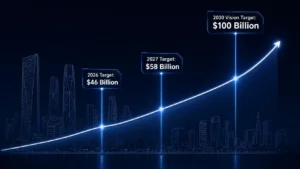
The sheer scale of riyadh foreign investment 2026 is best understood through hard data. According to the Ministry of Investment Saudi Arabia (MISA), foreign direct investment inflows reached a staggering SR26.6 billion ($7.09 billion) in the first quarter of 2026 alone. This rapid surge is not accidental; it represents a highly calculated trajectory designed to hit the saudi arabia $100 billion FDI target by 2030.
To support this massive capital allocation, regulatory bodies have acted swiftly. In February 2026, the Capital Market Authority (CMA) implemented the updated saudi capital market foreign investor rules 2026, dramatically easing the registration process for foreign institutional investors, allowing direct access to Tadawul (the Saudi Exchange), and streamlining capital repatriation. Additionally, obtaining a MISA saudi investment license 2026 is now fully digitized, reducing setup times for international entities from weeks to less than 24 hours. This aggressive deregulation is a primary catalyst behind the robust saudi non-oil GDP growth 2026, which is outperforming traditional hydrocarbon sectors and attracting long-term, risk-adjusted institutional capital.
780+ Global Companies Moving to Riyadh: The RHQ Effect
At the heart of Riyadh’s economic acceleration is the riyadh regional headquarters program RHQ. Under this government mandate, multinational corporations wishing to bid on lucrative Saudi government contracts must establish their regional headquarters in the capital.
The results have exceeded all initial forecasts. As of mid-2026, more than 780 companies moved headquarters riyadh. Global giants such as PwC, Deloitte, PepsiCo, Unilever, and Schlumberger have transitioned their primary regional decision-making teams to the city.
The Major Incentive: Corporate entities that relocate under the RHQ framework enjoy a riyadh 0% corporate tax RHQ benefit. This includes a riyadh 30 year tax exemption headquarters guarantee covering both corporate income tax and withholding tax on profit repatriation, confirmed through official Saudi tax circulars.
This massive corporate migration has triggered a dramatic supply-demand imbalance in the commercial sector. With hundreds of multinational executive teams requiring premium workspaces, riyadh office rents surge 2026 trends have hit historic highs. CBRE data shows that prime Grade A office vacancy rates in Riyadh have plummeted to below 5%, driving a saudi arabia office market supply shortage 2026 that is pushing yields for commercial landlords well past regional averages.
Why Riyadh Real Estate Is the Biggest Beneficiary
The massive corporate migration is spilling directly into the residential sector, creating a highly lucrative environment for property investors. There are three fundamental reasons why invest in riyadh real estate is the premier investment thesis in the Middle East today:
1. The Population Explosion
Riyadh is undergoing a historic demographic expansion. Under the city’s master plan, the riyadh population growth 15 million 2030 target is actively on track, set to double the current population of 7.5 million within the next four years. This rapid growth requires an average housing supply expansion that is currently outstripping construction capacity, ensuring sustained demand for both sales and rental units.
2. Market-Leading Yields and Capital Appreciation
While mature real estate markets globally face stagflation and cooling yields, the riyadh real estate market 2026 is delivering world-class performance. Riyadh is producing a steady 7% to 9% gross rental yield on premium residential assets, paired with an annual capital appreciation rate of 8% to 15% in high-demand northern corridors. To see how this compares to other prime coastal markets, read our comprehensive rental yield comparison across Saudi cities.
3. Acute Supply Shortages
The influx of high-earning foreign expatriates has created a severe shortage of high-quality housing. Demand for villas for sale in riyadh and luxury residential units has surged, with rental rates in prime expatriate-favored districts climbing by over 19.6% year-on-year. Investors targeting off-plan launches are capitalizing on the rapid development cycle to lock in early-equity gains before project handovers.
Who Is Investing and Where the Capital Comes From
The capital flowing into Riyadh’s real estate is highly diversified, arriving from major financial centers worldwide:
UK and European Investors: The United Kingdom represents the single largest overseas demand pool for property in saudi arabia, accounting for over 14,300 monthly searches. High-net-worth individuals are actively targeting saudi arabia houses for sale and premium apartments as a stable geopolitical hedge. UK investors are particularly focused on the tax efficiency of the market, generating strong demand for saudi arabia property for sale.
South Asian Capital: High-net-worth buyers and expatriate professionals are driving a surge in indian investors buying property riyadh and pakistani investment in saudi real estate 2026. This segment is primarily focused on yield-generating residential assets, looking to capture the high rental returns driven by the executive expat population.
GCC Cross-Border Flows: Institutional gulf investors riyadh property market activities have reached new heights, with capital from Qatar, Bahrain, and the UAE flowing into commercial and hospitality pipelines.
Geopolitical Alignment: Strategic partnerships have paved the way for massive chinese investment riyadh saudi arabia in infrastructure and industrial zones. Concurrently, russian capital saudi arabia real estate acquisitions have increased as global asset managers seek stable, high-yielding currencies pegged directly to the US dollar.
The Foreign Ownership Revolution: REGA’s New Law
Historically, foreign ownership of real estate in the Kingdom was highly restricted. However, the landscape fundamentally shifted on January 22, 2026, when the saudi foreign ownership law 2026 (officially implemented by the Real Estate General Authority, REGA) entered into force.
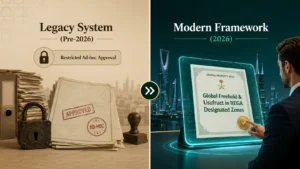
Under this new framework, non-Saudi individuals, corporate entities, and institutional funds can acquire direct freehold title and long-term usufruct rights (up to 99 years). This regulatory revolution allows you to buy property riyadh foreigner 2026 legally and securely through a digitized portal managed by the government.
The law has designated specific high-growth areas, known as REGA designated zones riyadh foreign ownership, where international buyers can purchase assets. These include the KAFD riyadh investment zone, the historic Diriyah Gate area, and transit-oriented development sectors near major Riyadh Metro stations. Importantly, these investments come with zero personal income tax on rental earnings, making Saudi Arabia one of the most tax-efficient wealth preservation vehicles globally. For a complete breakdown of the legal framework, requirements, and restrictions, consult our foreign investor guide to Saudi real estate.
Vision 2030 Mega-Projects Fueling the Boom
The primary engine behind Riyadh’s real estate transformation is the Public Investment Fund (PIF). The PIF investment strategy 2026-2030 has committed over $925 billion to develop historic giga-projects that are reshaping the physical and economic landscape of the capital:
Diriyah Gate Investment 2026 ($63B): A culturally significant heritage and lifestyle mega-project that is introducing high-end branded residences and luxury hospitality to Riyadh.
New Murabba Riyadh Downtown Project ($50B+): Slated to be the world’s largest modern downtown, centered around the colossal “Mukaab” tower, bringing over 104,000 residential units to the city center.
KAFD (King Abdullah Financial District): Riyadh’s premier financial hub, housing the headquarters of major regional banks, sovereign entities, and international consulting firms.
Qiddiya Entertainment City Investment ($8B+): A 334-square-kilometer destination southwest of the capital, designed to attract over 17 million visitors annually, driving the saudi entertainment sector growth real estate landscape.
Riyadh Metro Impact: A fully integrated 6-line, 176-station advanced transit network that is maximizing transit-oriented commercial property values across its corridors.
Riyadh Expo 2030 Real Estate Impact: The infrastructure pipeline constructed to host the World Expo is locking in billions of dollars in public works, ensuring Riyadh’s construction boom remains highly capitalized through the end of the decade.
This unprecedented infrastructure pipeline is creating highly localized investment hotspots. To see how these master plans tie into the broader national development goals, explore our comprehensive analysis of Vision 2030’s impact on Saudi real estate.
Riyadh vs Dubai: A New Kind of Competition
A common question among international wealth managers is whether Riyadh is set to replace Dubai as the financial capital of the Middle East. The reality is far more nuanced. Rather than replacing Dubai, Riyadh is establishing a parallel, highly complementary capital hub with distinct, yield-driven advantages.
| Metric | Riyadh (2026) | Dubai (2026) |
| Market Phase | Emerging High-Growth / High-Yield | Mature / Consolidated / Cyclical Peak |
| Average Gross Yield | 7% – 9% (Up to 8.89% in prime residential) | 5% – 7% |
| Annual Appreciation | 8% – 15% (Driven by acute supply deficit) | 4% – 6% |
| Tax Incentives | 0% Corporate Tax for RHQ (30-year exemption) | 9% standard corporate tax (Free Zone exceptions apply) |
| Foreign Ownership | Freehold/Usufruct in REGA designated zones | Freehold in designated nationwide zones |
| Growth Catalyst | Government-mandated corporate relocation & PIF | Global tourism, trade, and private sector expansion |
Riyadh represents a hyper-growth play backed by direct government capital expenditure, whereas Dubai remains a mature, highly liquid consumer market. For institutional portfolio diversification, smart capital is allocating across both cities—utilizing Dubai for immediate liquidity and Riyadh for explosive capital growth. To structure your own portfolio effectively, read our step-by-step guide on creating a strategic property investment plan in Saudi Arabia.
Secure Your Position in Riyadh’s High-Yield Market
Capital is deploying rapidly, and prime allocations within REGA designated zones are closing fast. Don’t navigate this complex macroeconomic shift alone.
Whether you need institutional advisory, corporate relocation assistance, or private wealth real estate placement, get direct expert guidance. Contact Mohamad Itani Real Estate Advisory today to book your private investment consultation.